
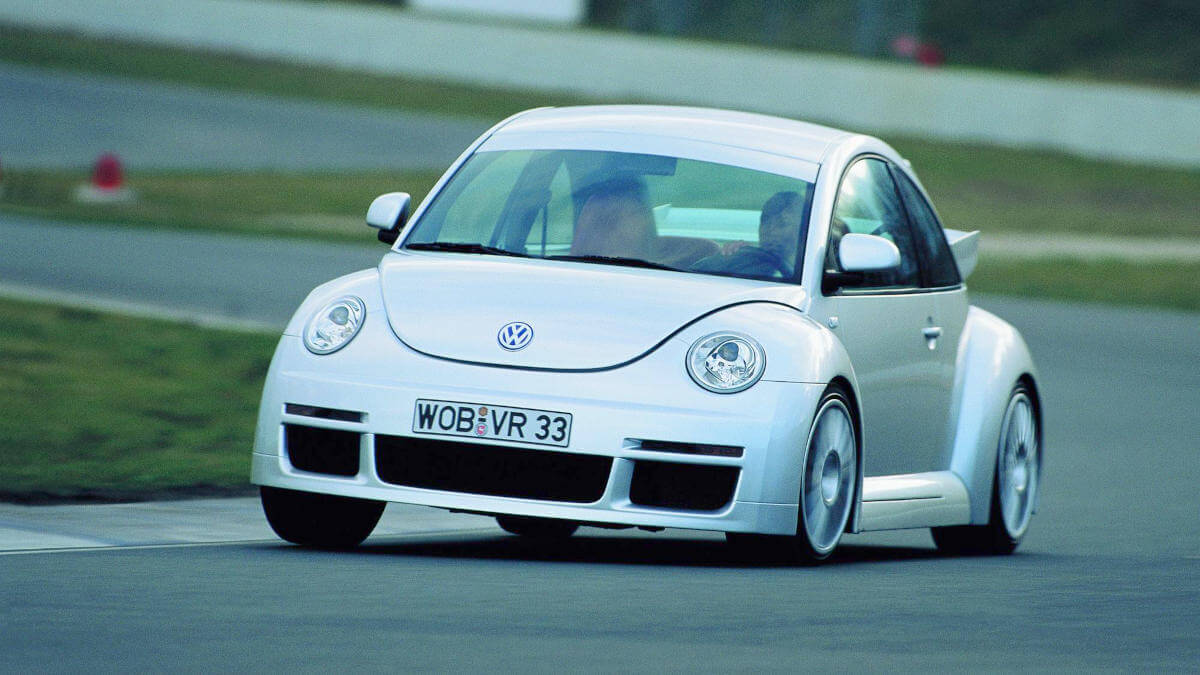
The RSi was Volkswagen's answer to a question nobody had asked: what if the New Beetle, the retro-styled, cheerful runabout that had been relaunched in 1998 was rebuilt as a serious performance car?
The answer involved borrowing the 3.2-litre narrow-angle VR6 engine from the Golf R32, detuning it slightly to 224 horsepower for packaging reasons, and combining it with a version of the 4Motion four-wheel drive system and a six-speed manual gearbox. The Remus sports exhaust was standard. The suspension was lowered and stiffened significantly. The interior received Recaro seats, aluminium trim, and a level of specification completely at odds with the standard Beetle's proposition.
Only 250 were built. Volkswagen made them in one colour: Reflex Silver. Every car is left-hand drive. Every car has the same engine, the same gearbox, the same specification. There are no variants, no special editions within the special edition, no automatic transmission option.
250 cars. That is all there will ever be.
The RSi is a textbook example of unexpected scarcity driving collector value. Nobody was monitoring the RSi market in 2005, or 2010, or even 2015, because nobody expected a New Beetle regardless of specification to become a collector car.
That assumption created the mispricing that produced the returns. The buyers who acquired RSis at £20,000 to £35,000 were not buying hype or following a recognised collector trend. They were buying something objectively rare, objectively interesting, and objectively undervalued by a market that had not yet done the arithmetic on 250 total production.
The arithmetic is being done now. £68,000 for the best examples, with a trajectory that continues upward as the global collector community discovers what this car actually is.
The Pattern Worth Noticing
The RSi's story contains a lesson that applies well beyond Volkswagen Beetles. The cars that produce the strongest investment returns are frequently not the obvious choices. The Ferraris and Porsches that everyone already knows about. They are the unexpected ones. The cars where a major manufacturer briefly built something extraordinary and then stopped, without the market paying sufficient attention.
The Golf GTI Mk2. The BMW 1M. The Alfa Romeo GTA. The RSi sits in this category. A moment of manufacturer ambition that the collector market priced incorrectly for twenty years and is now correcting.
What to Look For
All 250 RSis are Reflex Silver and left-hand drive, which simplifies the buying decision considerably. Specification variation is minimal. What matters is condition and documentation.
The Remus exhaust and Recaro seats are expensive to replace or restore. Favour examples where these are original and undamaged. Service history matters: the VR6 is a solid unit but benefits from documented maintenance. Avoid cars with suspension modifications or aftermarket wheels. Standard specification is everything in a 250-unit production run.
The supply of genuinely clean, unmodified examples is smaller than 250 suggests. Buy the best you can find.
Don't buy the wrong cars. I've helped 5,000+ car guys go from buying bad cars that lose them money to owning good cars that don't depreciate. I've manually put together a non-generic list of the 100 best investment cars to buy in 2026 — under-appreciated, last of their kind, and where the market of buyers is going.

Share:
Ferrari 430 16M: The Naturally Aspirated Special That's Quietly Tripled in Value
The BMW M4 CSL Is Misunderstood. And Significantly Mispriced