
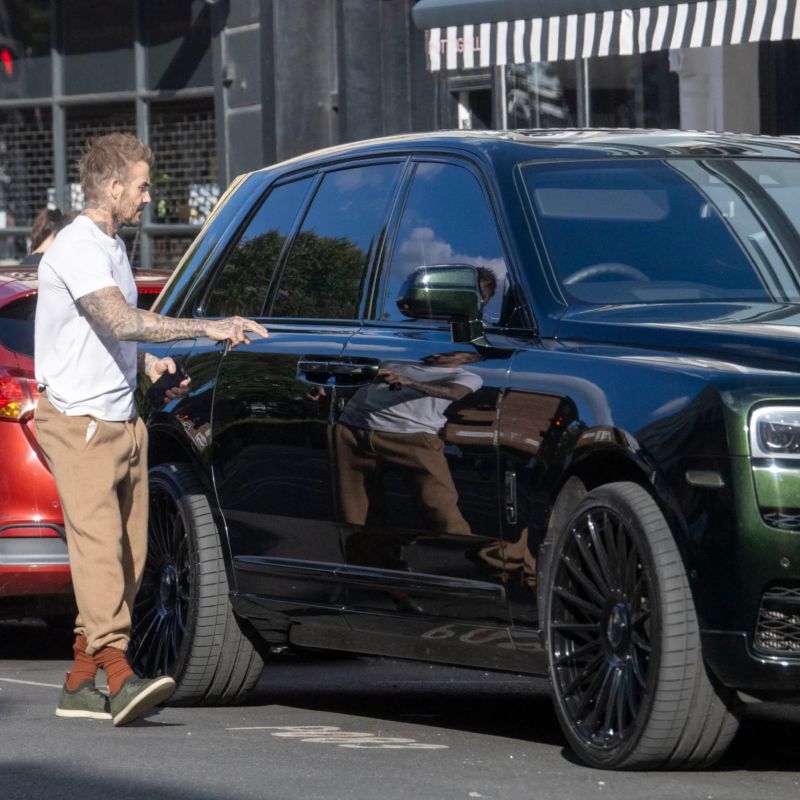
This Is David Beckham's Rolls-Royce Cullinan. He Has Lost £180,000 on It.
David Beckham is many things. A former England captain. A global brand. A man with demonstrably excellent taste, in food, in fashion, in architecture, in the restoration of a farmhouse in the Cotswolds that made an entire generation of interior designers rethink their relationship with reclaimed stone.
On this occasion, his taste in cars has cost him £180,000.
Beckham's Rolls-Royce Cullinan, finished in Dark Green, was purchased new in 2022 for approximately £400,000. Today, that same car is worth around £220,000. A loss of £180,000 in four years. Adjusted for inflation, because £400,000 in 2022 bought considerably more than £400,000 does, today the real loss is closer to £240,920.
That is not a paper loss. That is real capital, permanently destroyed, simply by owning the wrong car.
The Cullinan Depreciation Curve
The Rolls-Royce Cullinan is one of the most beautiful luxury SUVs ever produced. The V12-powered flagship SUV offers a standard of interior craftsmanship that nothing from any other manufacturer can match. The Bespoke programme means that no two Cullinans are truly identical. It is, by any honest assessment, the finest expression of what a luxury SUV can be.
It is also a volume luxury car and volume luxury cars depreciate. Significantly, predictably, and without exception.
The data is unambiguous. A Rolls-Royce Cullinan loses 40.2% of its value after five years, according to analysis of over 15 million vehicle transactions. The three-year figure sits at 17.7%. The seven-year figure reaches 57.4%. Applied to a £400,000 purchase, those numbers translate as follows: worth approximately £329,000 after three years. Worth approximately £239,000 after five years. Worth approximately £170,000 after seven years. Some 2019 Cullinans are now available for less than £160,000 — from original owners who paid £325,000 or more, with some having spent over £500,000 once options were added.
Beckham's Dark Green example is somewhere on that curve. £400,000 in 2022. £220,000 today. £180,000 gone in four years. At that rate, that is £45,000 per year. £3,750 per month. £865 per week, before insurance, before servicing, before fuel, before the cost of the capital itself sitting in a depreciating asset rather than working elsewhere.
Why This Keeps Happening
The Cullinan's depreciation is not a bug. It is a feature of what the car is. Rolls-Royce builds thousands of Cullinans annually for a global client base of wealthy buyers who want the newest specification. When a new specification arrives, the Series II facelift landed in 2024, every previous-generation car takes a step down in the secondary market as supply increases and buyers move on. The first owner absorbs the steepest part of the curve. Beckham's 2022 car is now a Series I, in a market being supplied by Series I owners who have moved to the Series II.
This is not specific to Beckham. It is the rule for every Cullinan bought new. All luxury cars tend to suffer from this problem, mainly because their wealthy owners want to maintain having the latest model with the newest design and technological advancements. The Cullinan's wealthy buyers discard it as the next specification arrives, and those with money don't want the previous one. The value falls through the floor, with most of the damage done in the first five years.
What makes the Cullinan loss particularly striking is the absolute number. £180,000 is not an abstraction. It is the purchase price of a Ferrari 360 Manual at the right moment in 2015. It is a deposit on a Porsche 997 GT3 RS. It is the full cost of a clean Lamborghini Gallardo manual, the last gated-shift V10 Lamborghini ever made, at the price it commanded twelve months ago, before it appreciated another £60,000.
Beckham can absorb £180,000 without it changing his life. The lesson his Cullinan teaches is one that applies to everyone spending serious money on a car: the vehicle you choose determines the financial outcome, not the amount you spend.
The Cars That Don't Do This
The cars that hold value, and the cars that grow in value, share a consistent set of structural characteristics that the Cullinan does not possess. Genuine scarcity, with a fixed production ceiling that cannot be raised. An irreplaceable character that no new car can replicate. A growing pool of buyers competing for a supply that can only decrease. And a moment in the market cycle where the asset is priced below what its significance will eventually demand.
The Cullinan has none of those characteristics. It is produced in volume, will continue to be produced in volume, and will continue to depreciate in line with the curve that every Cullinan before it has followed.
The cars that do have those characteristics exist at every price point, from £50,000 to £5,000,000. Finding them requires knowledge, not luck. And the difference between owning one of them and owning a 2022 Rolls-Royce Cullinan, over four years, is £180,000.
Don't buy the wrong cars. I've spent a significant amount of time putting together a non-generic list of the 100 best investment cars to buy in 2026, under-appreciated, last of their kind, and where the market of buyers is growing.

Share:
Buying This Aston Martin Is an Expensive Mistake. The 007 Edition Lost £41,000 in 5 Years.