
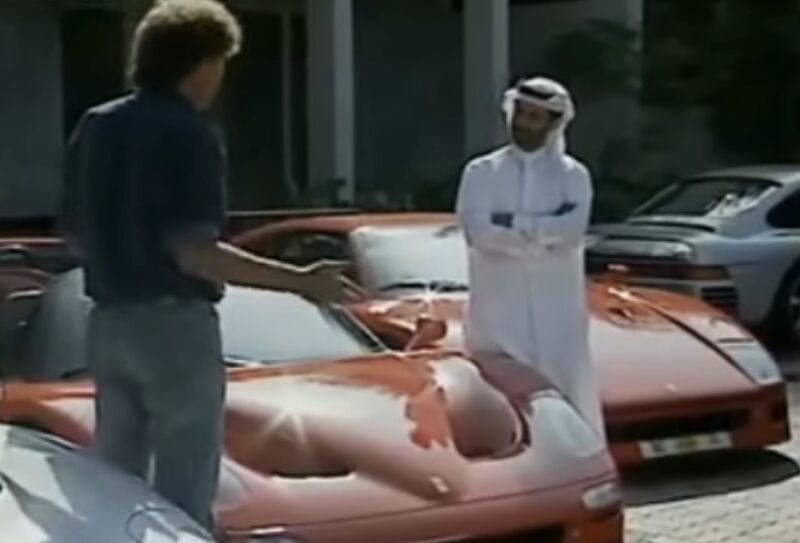
Clarkson Called It "a Very Bad Car." It Just Sold for $14.575 Million.
In the 1990s, Jeremy Clarkson drove a Ferrari F50 and returned one of the most withering verdicts in the history of British motoring journalism. He described the experience as being like "a furious spinning washing machine full of bricks." He called it ugly. He said it was "a very bad car." He said he much preferred the F40.
He was not alone. The critical consensus on the F50 at launch was surprisingly hostile for a car that cost £345,000 and carried the Ferrari name at the peak of its prestige. The F40 it followed was universally beloved, the last car personally approved by Enzo Ferrari, raw, turbocharged, brutal. The F50 came after, and the market and the press judged it accordingly. Harshly.
On 15 August 2026 at Mecum's Monterey auction, a 1996 Ferrari F50 in Giallo Modena, one of only 31 examples ever painted in this yellow, number 239 of 349 produced, sold for $14,575,000. A new public auction record for the model. The second time in 2026 alone that Mecum had broken the F50 record.
So was Clarkson simply wrong? Or did the market eventually recognise something he didn't?
The Price Trajectory
The numbers tell a story that is almost impossible to argue with:
2010: $660,000
2015: $1,232,000
2020: $3,222,500
2024: $5,505,000
2025: $9,245,000
2026: $14,575,000
From a car that cost £345,000 new in 1995, and that a significant number of critics and journalists dismissed as ugly, harsh and inferior to its predecessor, to one that just sold for more than $14.5 million in thirty years. That is not a bubble. That is a systematic repricing of an asset that the market chronically undervalued for two decades.
For context: only three F50s have ever cleared $10 million at public auction, and two of them sold within the same week in August 2026. The same Monterey Car Week also saw an F40 set a new record at $8.4 million. The car Clarkson preferred has now been surpassed by the car he dismissed, by a margin of more than $6 million.
What Clarkson Got Wrong And What He Got Right
It is worth being fair to Clarkson here, because his criticism of the F50's driving experience was not entirely without basis. The F50 was, genuinely, a difficult car. It was derived from Ferrari's Formula One machinery, the 4.7-litre naturally aspirated V12 was a direct development of the engine used in Alain Prost's 1990 Ferrari 641 Formula One car. The rear suspension attached to the engine casing, exactly as in a racing car. The ride was brutal. The noise was immense. The whole experience communicated, persistently and emphatically, that this was not a car built to be comfortable.
What Clarkson assessed as a flaw, the relentless, uncompromising nature of the F50's driving experience, is precisely what the collector market has eventually priced as a virtue. In an era when every new supercar is softer, heavier, more electronically managed, and more regulated than what came before it, a naturally aspirated V12 road car with no power steering, no ABS, no traction control, and a carbon fibre monocoque chassis derived from Formula One is not a bad car. It is an irreplaceable one.
The car the market discovered over the following thirty years is exactly the car Clarkson drove in the 1990s. Nothing changed about the F50. What changed was the world around it.
Why the Record Will Not Hold for Long
The specific car that achieved $14,575,000 was exceptional even within the F50 market. One of 31 Giallo Modena examples. Original matching chassis, engine, gearbox and bodywork. Ferrari Classiche certified with the Red Book. Approximately 4,500 miles at time of sale. Accompanied by the original Schedoni luggage set, factory tools, the F50 flight case, and a pair of TOD's Ferrari F50 driving shoes in size 7.5. Everything present and correct.
But the broader F50 market is moving regardless of individual specification. Two records in a single calendar year, January 2026 at Mecum Kissimmee ($12.21million), August 2026 at RM Sotheby's Monterey (12.105 million for the Mike Tyson example), and August 2026 at Mecum Monterey ($14.575 million), represents something more than auction day enthusiasm. It represents a systematic repricing of a car that the market spent twenty years undervaluing while it figured out what it was.
The F50 is approaching its 30th anniversary. A generation of collectors who grew up with it as the poster car they were not allowed to have, who read Clarkson's review, who absorbed the consensus that it was the lesser Ferrari, who later began doing their own homework on the Formula One engine and the carbon fibre monocoque and the 349-unit production run, is now old enough and wealthy enough to compete seriously for the best examples. That pool of buyers is not shrinking. The supply of 349 cars is not growing.
The washing machine Clarkson complained about has just sold for $14.575 million.
We have researched the F50 thoroughly and created an 11-page guide covering exactly what makes it so special, and where its value could go next.
Read our full Ferrari F50 Investment Guide for free


Share:
Manual Gallardo vs Lamborghini Temerario: A £160,000 Difference in One Year!