
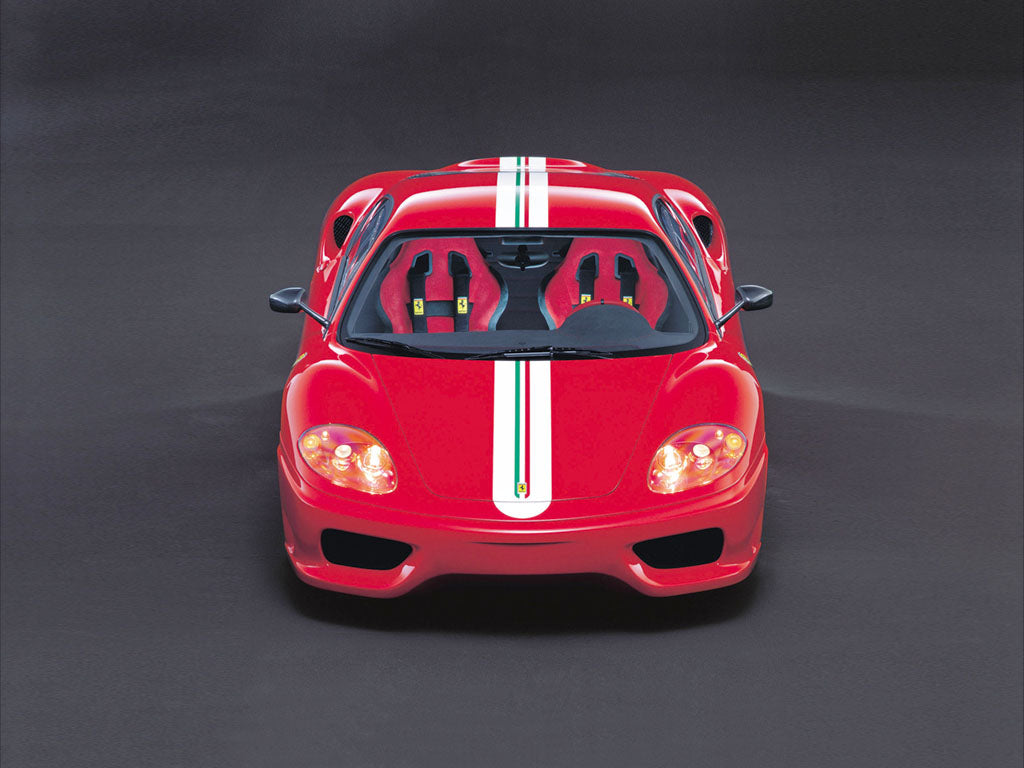
What the Challenge Stradale Is
The Ferrari 360 range ran from 1999 to 2005. The standard 360 Modena was a 3.6-litre naturally aspirated V8 producing 400 horsepower a genuinely great car that sold in significant numbers and gave a generation of buyers their first experience of a mid-engined Ferrari V8.
The Challenge Stradale was something else entirely.
The power went up to 425 horsepower. The kerb weight dropped to 1,255kg 110kg less than the standard car, through the extensive use of carbon fibre and the deletion of sound deadening, carpets, and comfort equipment that most buyers would never have missed. A naturally aspirated V8 at 8,500rpm. 1,255 kilograms. This is the car the engineers built when they were allowed to prioritise the driver above everything else.
Only 1,288 were produced. Not all survived in the condition required to qualify as investment-grade.
The 2018 Pricing Window
In 2018, the 360 Challenge Stradale sat at $185,000 in the US market. The mainstream market had moved on to the 430, the 458, and by then the 488. The Challenge Stradale was appreciated by enthusiasts but had not yet been properly repriced by serious collectors.
The buyers who stepped in at $185,000 were not buying hype. There was no hype. They were buying a car with extraordinary fundamentals. Rarity, raw driving experience, motorsport DNA, and a production run that was fixed and finite, at a moment when the market had not yet done the arithmetic correctly. The arithmetic has since been done. $1,000,000 for a clean, standard, correctly documented example. With one green example selling for over $1,800,000.
Why the Numbers Moved This Far
The Challenge Stradale's appreciation is not simply a function of age. Many cars age without appreciating. What the CS had and what drove the repricing was a specific combination of factors that the collector market responds to reliably.
The naturally aspirated, high-revving V8 is irreplaceable. Ferrari's current V8 road cars use twin-turbocharged hybrid engines. The sensory experience of the CS at eight thousand rpm is not available from any new Ferrari at any price. That is a fundamental scarcity.
The lack of electronic intervention is a collector characteristic. Cars stripped of safety systems properly, by the manufacturer, as a deliberate engineering choice are vanishingly rare. The CS is one of very few road-legal Ferraris where the driver is genuinely in charge.
The production number is small enough to matter. 1,288 cars across global production, with an unknown proportion in the genuinely collectible condition required to attract serious buyers. The effective supply of investment-grade examples is considerably smaller than 1,288.
What This Means for 2026
The Challenge Stradale at current values is not an entry-level purchase. But for buyers who are thinking about what the collector market rewards over time and who understand that the cars generating these returns are not random it is an important case study.
The pattern here is precise and repeatable: last of their kind, mechanically irreplaceable, produced in small numbers, from Ferrari, at a moment when the market has undervalued them relative to their eventual position. We are watching versions of this pattern develop right now in the 430 Scuderia and 458 Speciale markets.
The CS was $185,000 in 2018. The question worth asking is which car today is sitting at the equivalent moment.
Don't buy the wrong cars. I've helped 5,000+ car guys go from buying bad cars that lose them money to owning good cars that don't depreciate. I've manually put together a non-generic list of the 100 best investment cars to buy in 2026. Cars that are under-appreciated, last of their kind, and where the market of buyers is going.

Share:
Audi RS4 B7 Avant vs New RS5
Ferrari 430 16M: The Naturally Aspirated Special That's Quietly Tripled in Value